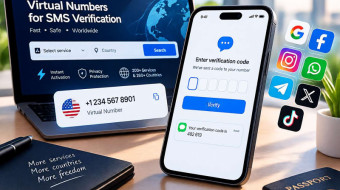



Anyone who has ever signed up for a new app knows the moment: the form asks for a phone number, and you have zero desire to link your personal contact to yet another service. Some people end up receiving promo texts for months from a site they used once. There are three classic solutions to this problem — a virtual number, an eSIM, and Google Voice. They aren't interchangeable: each tool solves its own specific task, and confusing them is usually what leads people to pay for something that doesn't actually fit their needs.
Quick Comparison: How They Differ
|
Parameter |
Virtual Numbers |
eSIM |
Google Voice |
|
Price |
From a few cents per number |
More expensive |
Free (with limitations) |
|
Speed to obtain |
Instant |
A few minutes |
Slower |
|
Duration of use |
Temporary, task-specific |
Long-term |
Long-term, but with regional restrictions |
|
One-time verification |
Excellent option |
Overkill |
Average |
|
API automation |
Available on most services |
Limited |
None |
Virtual Number: A One-Time Pass, Not a Second Phone

A virtual number isn't a "backup number" — it's more like a single-use key to a door you only need to open once. It's issued online in seconds, with no physical SIM required, and is typically used for exactly one purpose: receive a code and forget about it.
Who uses it:
-
Someone signing up on a forum, marketplace, or app who doesn't want that number showing up in someone else's mailing list database later
-
A developer who needs to run SMS verification testing in their own app without pulling in colleagues' personal phones
-
A startup entering a new market that wants a local number for a country where it doesn't yet have a physical office
-
A traveler who wants to complete verification for a local taxi or banking app in advance — before even landing at the airport
Best choice for:
-
One-time SMS confirmation
-
Verification that requires a number from a specific country
-
Any situation where the number is needed once and won't be reused
Not the right choice for:
-
Needing a number for ongoing incoming calls
-
Situations where you need a guarantee the number will keep working for years — that's simply not what a virtual number is designed for
Strengths:
-
Issued in seconds
-
Huge selection of countries and carriers
-
Your personal number stays personal
-
Quality providers, including Second Number, offer reliable SMS delivery and access to numbers from 180+ countries, with automatic refunds to your balance if a code never arrives
Weaknesses:
-
Quality depends heavily on the provider — cheap services sometimes offer numbers that have already been used, and some platforms simply reject those
-
Not suitable if you need a permanent inbound number
eSIM: A Second Number That Stays With You Long-Term

If a virtual number is a key for a single entry, an eSIM is a full second SIM card — just digital. It's embedded in the device and connects to an actual mobile carrier: calls, texts, data, everything a regular SIM does, just without the plastic.
Who uses it:
-
A traveler who wants to activate a local plan right after landing, without digging out the SIM tray with a paperclip
-
Someone who keeps two numbers on one phone — personal and work — and doesn't want to carry two devices
-
A freelancer or digital nomad who needs a stable local number while keeping their "home" number active
-
Someone for whom a number isn't just a formality but a permanent point of contact: banking alerts, important services, business correspondence
Best choice for:
-
Needing one number long-term, with full connectivity
-
Separating personal and work communication on a single phone
-
Getting a local plan while traveling without swapping a physical SIM
Not the right choice for:
-
Needing to quickly get many different numbers for one-off tasks — an eSIM is overkill and more expensive here
-
Devices that don't support eSIM — still an issue for some budget and older models
Strengths:
-
Full connectivity: calls, texts, data
-
No need to swap a physical card
-
Works great for a number used regularly and long-term
Weaknesses:
-
More expensive than a one-time virtual number
-
Inconvenient if you need a new number for every new task
Google Voice: Free, But With Caveats

Google Voice used to be almost the default choice for a free US number. By 2026, it's more of a niche tool — convenient within the Google ecosystem, but with clear limitations.
Who uses it:
-
Someone who wants a free number for calls and texts through the Google Voice app
-
Someone who wants one number across multiple devices without tying it to a physical or digital SIM
-
A US or Canada resident who occasionally needs a second number — for voicemail, for example
Best choice for:
-
A free backup number for calls in supported regions
-
Voicemail and call forwarding within the Google ecosystem
Not the right choice for:
-
Verification on services that filter out VoIP numbers — some platforms simply won't accept them
-
Use outside supported countries — functionality is heavily restricted
-
Situations where reliable SMS code delivery is critical
Strengths:
-
Free
-
Integrates with the Google ecosystem
Weaknesses:
-
Availability and stability for new users in 2026 are limited, with some features unavailable in many countries
-
Not always accepted by services that block VoIP numbers
Choosing at a Glance

If you need a number for a single, one-time task — go with a virtual number; it's the fastest and cheapest option. If you need a full second number you'll use for months — look toward an eSIM. Keep Google Voice in mind as a free backup option, but with the caveat that it's not accepted by every service.
Conclusion
The three tools aren't competitors — they're three answers to three different questions. A virtual number covers one-time verification, an eSIM covers ongoing connectivity, and Google Voice offers a free but limited backup. Choosing the right tool for the task saves both money and hassle — there's no need to buy a long-term solution when a one-time code would have been enough.
If you're looking for a virtual number service with a good balance of price and quality, take a look at Second Number.

It provides access to numbers from more than 180 countries for receiving SMS and OTP codes on popular platforms — Telegram, WhatsApp, Instagram, Google, TikTok, and others — with prices starting at just a few cents per number. If the SMS does not arrive, the money is automatically refunded to your balance. For developers and businesses, there's a straightforward API; for those who need numbers in bulk, there are wholesale discounts; and for iOS users, there's a dedicated mobile app.