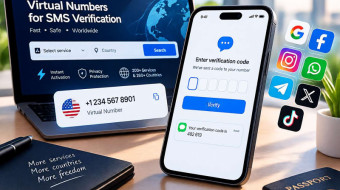



"This number type isn't supported" is one of the most common, least explained rejections in phone verification. The mechanism behind it — VOIP detection — is worth knowing before wasting attempts on a temp number that was never going to clear that specific platform. Plenty of people searching non voip number free, or the longer free non voip number for sms verification, are really just trying to understand why a signup keeps bouncing.
What VOIP Means
Voice over IP routes calls and texts through internet infrastructure instead of a traditional carrier. Rental services and most virtual numbers run on it because provisioning is cheaper and faster than physical SIM stock. The technology isn't inherently suspicious — it's simply detectable at the registration-data level, and platforms use that as a cheap filter.
Why Platforms Check This
Carrier registries and number-lookup databases tag every block as mobile, landline, fixed VOIP, non-fixed VOIP, or prepaid at the moment it's provisioned. Banks and fintech apps query that tag and reject or scrutinize anything marked VOIP, on the logic that a genuine one-time signup more likely comes from a standard mobile line than a bulk-provisioned range. Legitimate use gets caught alongside real fraud, which is why "non-VOIP number" became its own search term.
Checking a Number's Status, Step by Step
-
Run it through a public lookup tool before relying on it for anything high-stakes.
-
Check the returned line-type field.
-
If the target platform is known to be strict, confirm whether a non-VOIP line is actually required first.
-
If rejected, switch providers or countries rather than retrying the same digits.
What a Rented Number Is, Classification-Wise
A number from a service like this registers as VOIP by definition — the infrastructure that makes rental possible in the first place. It receives one SMS per verification and nothing more; no calls either direction, and no reservation for a second message once the first lands. The same logic applies whether the search that led here was temporary number for otp, number for otp, or the more specific temp no for otp — all describe the identical one-time mechanism. For platforms with low or moderate strictness, this classification rarely matters. For the strictest category, switching numbers won't get around a policy built specifically to filter this line type — that's where an actual personally-owned number becomes necessary.
How Registration Data Gets Classified
Every number carries a line-type field set once, at provisioning, maintained by carrier registries and resold through lookup databases. A brand-new, never-used VOIP number can be tagged the instant it's issued, regardless of how it's used afterward — classification tracks how the number was provisioned, not behavior.
Where Strictness Sits
|
Platform category |
Strictness |
Result |
|
Banking, fintech |
Very high |
Often blocks virtual numbers outright |
|
Government services |
Very high |
Frequently requires a resident-registered number |
|
Social apps |
Moderate |
Occasional extra checks, rarely a hard block |
|
Messaging apps |
Low to moderate |
Usually clears, may throttle fast registration |
|
Marketplaces, classifieds |
Low |
Generally accepts any working number |
Hard Block vs. Soft Block
A hard block refuses the number outright at entry, before any code sends — the clearest signal. A soft block accepts the number and appears to send a code that never arrives, or arrives too late to matter. Harder to diagnose, since it looks identical to ordinary network delay.
The US Regulatory Backdrop
US carriers now run STIR/SHAKEN, a call-authentication framework requiring caller ID verification before a call completes, aimed at robocalls and spoofing rather than SMS verification directly. It's part of a broader regulatory push toward stricter number attestation that's made both carriers and platforms more willing to flag ranges they can't fully verify the origin of — VOIP included. Line-type trust also splits further than a simple VOIP-or-not split: postpaid mobile sits at the top since it's tied to an ongoing billing relationship, prepaid sits in the middle, and non-fixed VOIP — the category most rentals fall into — sits at the bottom precisely because it carries no address tie at all.
Signs of a VOIP Block
A code that never shows, with no error at all, means it got filtered before sending rather than lost in transit. An explicit "unsupported number type" message at entry means the platform rejected before a code was even requested. Both trace to the same root: registration data checked and rejected before delivery.
What Actually Helps
A different country sometimes clears it, since strictness varies by region and carrier agreement. Switching providers helps more often — not every pool carries the same reputation with a given blocklist. For the strictest platforms, though, no amount of switching gets around a policy working exactly as designed; confirming that early saves burning through rentals for nothing.
Frequently Asked Questions
Are all rented virtual numbers classified as VOIP?
Yes — the underlying tech making rental possible.
Can a VOIP number take a second code after the first?
No — scoped to one verification.
Does VOIP classification mean less security?
No — it's a delivery-infrastructure label, unrelated to how securely a code transmits.
Why does a code sometimes never show, with no error?
Typically a silent block, filtered before sending.
Can a rented number be made to appear non-VOIP?
No — set at the carrier level when provisioned.
Do all platforms check the same way?
No — strictness ranges from hard blocks on banking apps to essentially nothing on many marketplaces.
Bottom Line
VOIP detection is a blunt filter, catching legitimate use alongside its actual target. For most everyday verification, Second Number's broad country and carrier coverage means a blocked virtual number costs a couple of minutes to replace, not an afternoon of troubleshooting.