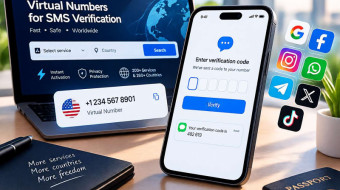



An OTP — one-time password — is a short numeric code generated fresh for a single login or signup, dead the moment it's used or its timer runs out. Anyone typing "otp is what" into search is really asking the same question this whole page answers. It shows up on banking apps, social platforms, work logins. The mechanics behind that six-digit text explain most of why codes fail sometimes.
How an OTP Gets Generated and Delivered
A server produces a random code, stores it against the account with an expiration timer usually between one and ten minutes, and pushes it through whatever channel is on file — SMS most often, sometimes a voice call reading digits aloud, occasionally a push through an authenticator app. A virtual number covers only the SMS path here. It gets typed back, the server checks the match, and access follows within the window. Used or expired, that code is discarded permanently — it can't be replayed even by mistake.
Receiving an OTP With a Rented Number, Step by Step
-
Start the platform's flow and reach the phone-entry step.
-
Enter the temp phone number in the requested format.
-
A numeric OTP arrives by SMS.
-
It shows up in the dashboard within seconds.
-
Enter it before the short window closes.
What This Kind of Line Covers, and Where It Stops
A number taken specifically for OTP delivery catches exactly one incoming SMS. It can't take or make calls, so any platform relying on a voice-read code won't work here — that path needs an actual phone line. It also doesn't sit in reserve for a second OTP later; once the first lands and gets used, that verification is closed. A new OTP requested for a different action days later is a separate event, needing its own fresh number.
Why Codes Sometimes Don't Work
Most failures come down to a handful of causes: the timer ran out before entry, the wrong channel fired — a text-only line getting a call attempt instead — the sending platform queued messages during a traffic spike, or the receiving digits were already flagged, with delivery silently blocked. None of this means the OTP mechanism itself is broken; it's a mismatch somewhere in delivery.
OTP, 2FA, TOTP
OTP is the code. Two-factor authentication is the broader practice — something known, like a password, plus something held, like a phone that can receive a code. TOTP is a specific standard generating rotating codes every 30 seconds on-device, distinct from a server texting a fresh one per request.
Delivery Channels Compared
|
Channel |
Speed |
Works with a text-only line |
Weak point |
|
SMS |
Usually seconds |
Yes |
Fails if the number is flagged or unreachable |
|
Voice call |
Slower, depends on answering |
No |
Needs a number that can take calls |
|
Authenticator app |
Instant, offline after setup |
Not applicable |
Requires prior setup on the account |
|
|
Seconds to minutes |
Not applicable |
Only as secure as the inbox |
Why Codes Are Usually Four or Six Digits
Four digits give 10,000 combinations — quick to type, brute-forceable fast without rate limiting. Six push that to a million, the point most platforms settle on as impractical to crack within a normal window while staying easy to enter. Longer codes mostly show up in high-security banking contexts.
Where OTP Fits Into Regulation
In the EU, PSD2's Strong Customer Authentication rules made two-factor verification legally mandatory for most online payments starting in 2021, directly pushing OTP adoption across European fintech and e-commerce. That's part of why financial platforms lean on it so consistently — not just a security preference, often a compliance requirement with legal weight behind it. TOTP and HOTP split on the same underlying idea differently: TOTP generates codes from the current time plus a shared secret, which is why authenticator apps work offline, while HOTP uses an incrementing counter instead, more tolerant of clock drift but more fragile if that counter falls out of sync.
Delivery Speed by Region
Carrier prioritization for transactional SMS isn't uniform — some networks push verification texts ahead of regular message queues, others don't distinguish at all. A code landing in three seconds from one country's number might take twenty from another purely because of how that carrier handles automated traffic, not because anything's actually wrong with the number or the platform sending it.
Who Relies on This Setup
Developers checking their own OTP flow need repeatable, disposable numbers across countries without burning real lines — the same people who'd search get otp or number otp while debugging a broken test suite. QA teams testing a signup screen's error handling send themselves dozens of codes per session, each needing its own digits, sometimes tracked as otp number in their own test logs. Anyone signing up once, with no plan to receive further codes on the same line, gets exactly what a single rental offers.
What to Check Beforehand
Confirm the platform delivers by SMS, not exclusively by voice, before renting anything — a call-only flow won't work with this. Have the signup screen open before renting so the short window isn't wasted navigating menus. Treat each request as needing its own number rather than assuming one rental catches a second, unrelated code.
Frequently Asked Questions
Can a rented number take more than one OTP?
No — scoped to one code, one verification. Another request needs a fresh number.
Does this work for voice-based OTP delivery?
No — SMS-only, can't take calls.
Why do codes sometimes arrive late?
Usually the sending platform's own infrastructure queuing during high traffic.
Is a rented number less secure than a personal one for this?
No — the mechanism doesn't care what type of number receives it.
What happens if a code expires before entry?
Requesting a new one typically resets the timer.
Are OTP and TOTP interchangeable terms?
Not quite — OTP is the general term, TOTP specifically the time-based rotating algorithm.
Bottom Line
An OTP is a one-time gate, not standing infrastructure, and a rented SMS-only line matches that exactly. Second Number delivers precisely that: request a virtual number, catch the code, done — with broad country coverage for whichever platform is asking.