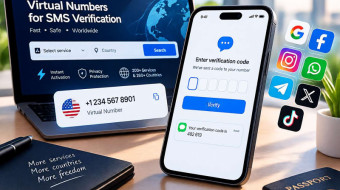



Telegram throttles registration harder than most messengers, and its own rate limiting is behind the "too many attempts, try again later" message so many people hit on a second account — often while holding nothing more than a temp phone number and no idea why the same request that worked yesterday just failed.
Why Registration Gets Locked Down So Tightly
Telegram tracks signup volume per number range, not per individual digit. A range that's absorbed a burst of new accounts recently gets throttled regardless of whether the specific virtual number in hand has ever been used. Identical rentals from one provider can succeed on the first try and stall on the next — recent activity on that range drives the outcome, not the line itself.
Verification, Step by Step
- Start the signup and enter the country plus the number.
- Check the dashboard right away — Telegram's SMS, when it fires, typically lands within 10 to 15 seconds.
- Past roughly a minute with nothing showing, stop waiting. A call usually gets offered next, which a text-only line can't catch — cancel and switch numbers.
- Enter the code exactly, including any leading zero the local format uses.
- Finish the profile — name, optional username. The number isn't requested again here.
What This Kind of Line Actually Covers
A number taken out for this catches one incoming code and nothing beyond it — technically an OTP, or number otp, the same mechanism Telegram shares with every other SMS-verified platform. No calls, and no standing reservation for a second Telegram message later — once the first check lands and gets used, that account's setup is closed. Delivery splits automatically between SMS and voice depending on what Telegram's system judges will land faster for a given range. A call substituted for a text looks, from the user's side, identical to a code that never showed — the real cause is a channel mismatch, not something waiting fixes.
Diagnosing "Limit Exceeded"
Searching limit exceeded telegram usually turns up the same advice repeated everywhere: wait, or try a different number. Here's what's actually behind each variant of the message.
| Trigger | What's happening | Fix |
|---|---|---|
| Recent signup spike on that range | Automated anti-spam throttle | Switch country or carrier |
| Repeated failed attempts on one number | Temporary lock after several tries | Wait it out, or move to a fresh line |
| IP flagged alongside the number | Network and number signals cross-checked | Try a different network |
| Global abuse wave | Platform-wide tightening during spam surges | Timing isn't controllable — retry later |
| A country recently overused | Regional threshold hit ahead of the individual line | Pick a less common country if allowed |
Why People Register a Separate Account
Community moderators keep bot and channel ownership apart from personal digits specifically so it can transfer to another team member without handing over a private line. Bot developers testing from the user side face the same constraint — a bot can't test its own conversation flow, so a second, disposable identity is the only way to see what a real person experiences. Anyone who's searched otp number or get otp while troubleshooting a Telegram signup is really asking the same underlying question — why this particular code, on this particular platform, didn't land the first time.
What Happens to the Number Afterward
Telegram doesn't re-request it for daily use — messaging, channels, groups all run independently of whether that original line stays reachable. It matters again only if a new device gets logged in via SMS instead of an existing session, which needs a fresh code and therefore a fresh number, since the first one already delivered its message.
Two-Step Verification Sits on a Separate Layer
Phone verification creates the account. Two-step verification — Telegram's cloud password — gets added afterward inside the app, entirely disconnected from how the number was sourced. Setting it shortly after registration keeps the account protected even once the original line stops being reachable.
Bots and BotFather Need No Number of Their Own
Creating a bot through BotFather requires no phone number at all — bot accounts authenticate through an API token issued to whichever user account created them, not through their own SMS check. The phone requirement applies only to the human account doing the creating. Migrating an existing account to a new number works differently again: Telegram's own Settings menu handles that as a deliberate move, verified by SMS the same way the original signup was, and it preserves chat history and channel ownership rather than starting fresh.
Country Choice Shifts Over Time
Telegram adjusts regional anti-spam thresholds continuously, not on a fixed schedule, so a country clearing instantly one week can hit friction the next for reasons that have nothing to do with a specific attempt. There's no way to predict this from outside — keeping access to a few different countries, the same way a temporary number for otp service would across other platforms, turns a blocked signup into a two-minute detour rather than a dead end.
What to Check Before Renting a Number
Match the country to what's actually needed — regional thresholds shift often, and a country that cleared instantly last week can hit friction this week for unrelated reasons. Keep the signup screen open before renting rather than after. If one attempt stalls, switch rather than retry the same digits; Telegram's temporary locks don't clear faster from persistence.
Frequently Asked Questions
Can one number register a second Telegram account later? No — once it delivers a code, it isn't held for another.
Why does Telegram sometimes call instead of texting? Automatic, based on what the system judges will land faster for that range — a text-only line can't pick up the call.
Does the account need the number to stay active afterward? No. Normal use runs independently of it.
What does "limit exceeded" actually mean? That number range got throttled from recent registration volume, regardless of the specific digits' history.
Is renting a number against Telegram's terms? No — the platform doesn't distinguish it from a personal one at registration.
Does retrying unlock a locked number faster? No, it usually extends the lock. Switching is faster.
Does the cloud password depend on the phone staying reachable? No — set independently inside the app.
Bottom Line
Clearing Telegram's verification comes down to catching one code fast and knowing a stall means a new number, not more patience on the old one. Second Number covers a wide enough range of countries that switching past a "limit exceeded" wall with a fresh virtual number takes minutes, not a wasted afternoon.